


I’m one of the few investors in Australia with an active interest in adtech, martech and media. This comes from my own experience – I built a digital media start-up back when digital media was disrupting the print industry, and before we were ourselves disrupted by the industrial money-vacuums that the social platforms became. What came of that journey is an appreciation of what it takes to build a start-up, and a deep interest in the state of media in Australia.
For anyone who’s been following the media industry, you can’t help but feel some dismay at the reduction in jobs in mainstream media. For every company that’s performing well – The Economist, the NYT – there are countless others in a constant cycle of reduced revenue, falling market cap and headcount reductions. Newsrooms that employed hundreds now run with dozens. Mastheads that defined cities have folded entirely. A simple view would be that media is in decline.
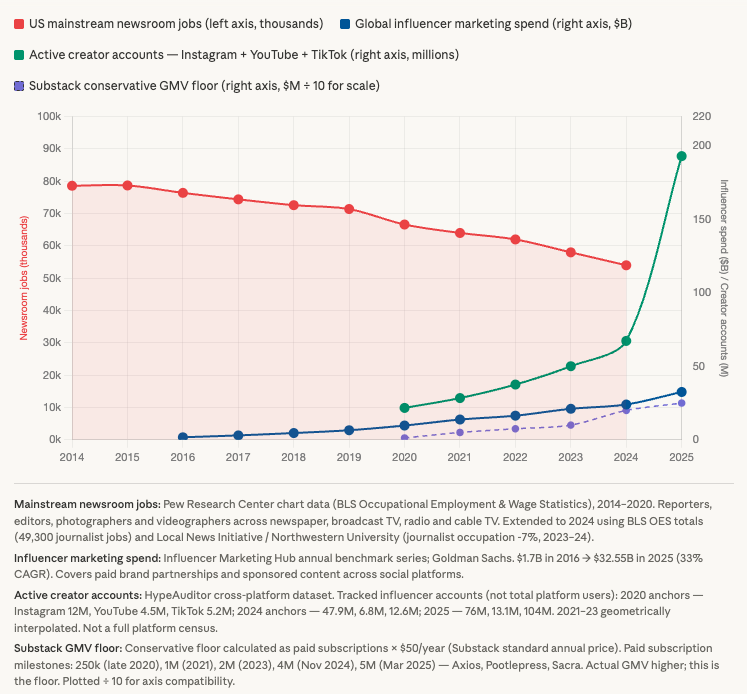
See sources for data points; not perfect by any means but directional
What has changed – as illustrated in the chart above – is the model. US mainstream newsroom employment has fallen from around 79,000 in 2014 to an estimated 54,000 by 2024, a drop of roughly 30%. Newspaper jobs alone have been cut by more than half over the same period. (The same pattern is evident in Australia and NZ also.) These are real losses, and real communities bear the cost of them in reduced local accountability journalism.
But look at the other lines. The global influencer marketing industry – money flowing to creators in exchange for their audiences’ attention – grew from $1.7 billion in 2016 to $32.6 billion in 2025. That is a 19-fold increase in under a decade, compounding at roughly 35% per year. The number of tracked active creator accounts across Instagram, YouTube and TikTok grew from around 22 million in 2020 to 193 million by 2025 (tracked creator/influencer accounts, not all of which are monetising or active). And Substack, where readers pay writers directly with no masthead in the middle, went from essentially zero to a conservative GMV floor of $250 million per year – and that is the floor, based on the standard $50/year subscription price. The actual average is higher.
YouTube alone has paid out more than $70 billion to creators and rights holders in the last three years.
What we are witnessing is not the death of media. It is a structural redistribution of who gets paid to produce it, and how.
The old model concentrated economic power in the hands of proprietors. A journalist at a metropolitan daily was paid a salary by an organisation that captured most of the value their work created – through advertising against their byline and through subscriptions sold on the masthead’s brand. The writer was an employee. The proprietor owned the relationship.
The new model inverts this. A creator on Substack owns their subscriber list. They take 90 cents of every dollar their audience pays them. A YouTuber with a strong niche can build a seven-figure business directly on the back of their audience’s loyalty. The top ten Substack writers collectively earn over $40 million a year. More people are earning a living from producing content today than at any point in history – and critically, the millionaires are now the producers of the content, not the proprietors of the infrastructure.
This shift raises legitimate questions. Questions about quality and verification, about content vacuums, and the concentration of power in a handful of platforms. The platforms are, in their own way, the new mastheads – and they extract their own form of rent.
But my point here is simply to observe the scale of what has happened. The total addressable market for media – audiences paying for content, brands paying to reach those audiences – has not shrunk. It has grown substantially. What has changed is who captures the value within it.
